
Google Ads strategy 2026
Google Ads remains one of the fastest and most powerful ways to generate leads and sales online. In 2026, competition is higher than ever — but so are the opportunities.
Many businesses lose money on Google Ads because they:
- Target the wrong keywords
- Ignore conversion tracking
- Send traffic to weak landing pages
- Fail to optimize campaigns
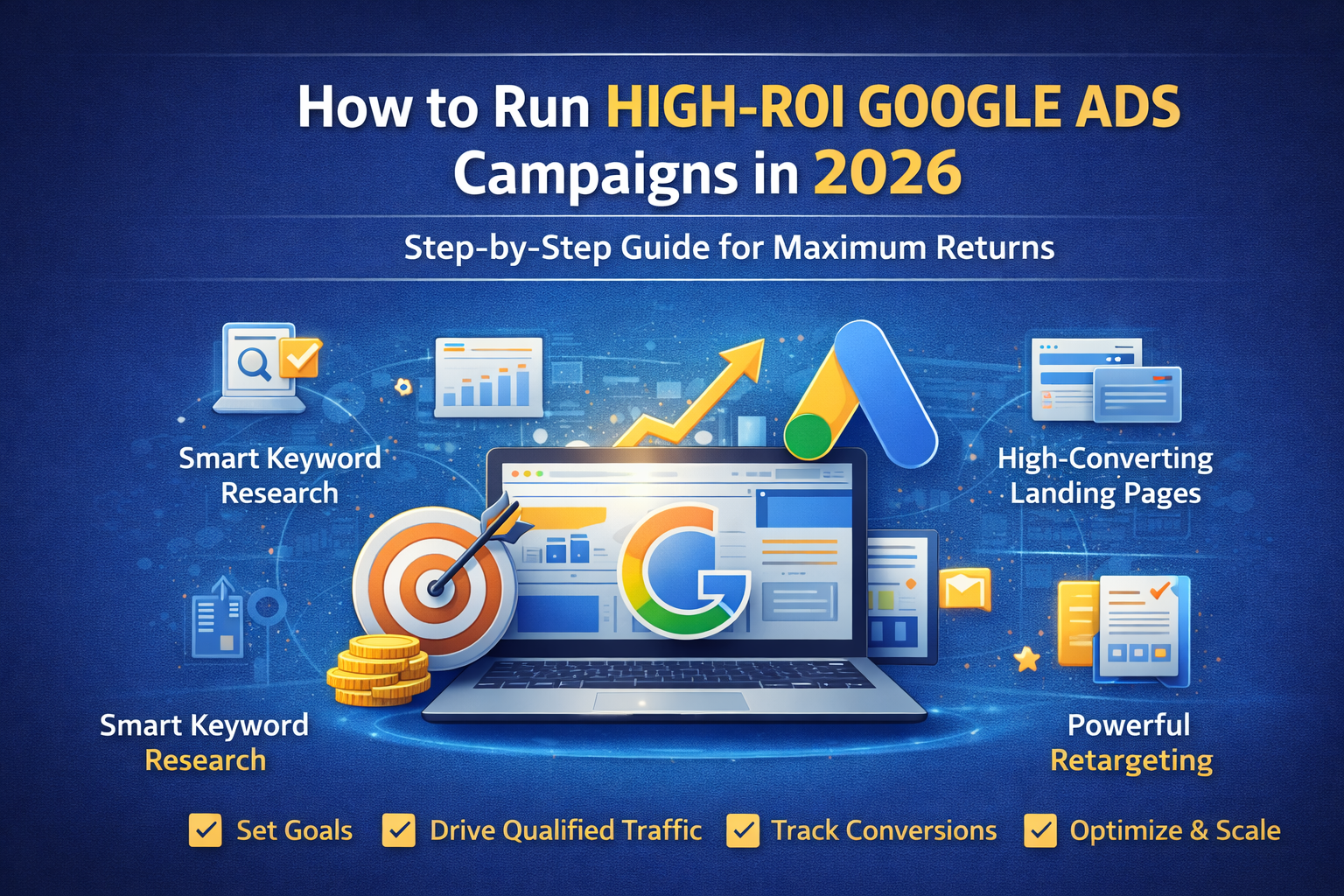
This guide will show you how to build high-converting, high-ROI Google Ads campaigns step by step — whether you are a beginner or scaling an existing account.
1. Why Google Ads Still Works in 2026
Google processes billions of searches daily. The most powerful part?
Users searching on Google often have high buying intent.
When someone searches:
- “Hire SEO agency”
- “Web development company near me”
- “Best digital marketing services”
They are ready to take action.
Unlike social media, Google Ads captures demand — it doesn’t interrupt users.
2. Types of Google Ads Campaigns You Should Use
2.1 Search Ads (Highest Intent)
These appear when users type queries into Google.
Best for:
- Lead generation
- Service-based businesses
- B2B companies
- High-ticket services
Search campaigns usually give the highest ROI when structured properly.
2.2 Display Ads
Banner ads shown on websites within Google’s network.
Best for:
- Brand awareness
- Retargeting
- Low-cost visibility
2.3 Performance Max Campaigns
AI-driven campaigns using automation.
Good for:
- E-commerce
- Multi-channel advertising
But requires strong data tracking to perform well.
3. Step-by-Step Google Ads Strategy for Maximum ROI
Step 1: Set Clear Goals
Before launching ads, define:
- Lead generation?
- Sales?
- App downloads?
- Brand awareness?
Without a clear goal, optimization becomes impossible.
Step 2: Smart Keyword Research
Focus on:
- Buyer-intent keywords
- Long-tail keywords
- Commercial phrases
Example:
Instead of:
“SEO”
Target:
“SEO services for small business”
“Affordable SEO company near me”
Avoid broad keywords that waste budget.
Step 3: Campaign Structure Matters
Organize campaigns by:
- Service category
- Location
- Target audience
- Match type
Example Structure:
Campaign: SEO Services
Ad Group 1: Local SEO
Ad Group 2: E-commerce SEO
Ad Group 3: Technical SEO
This improves Quality Score and lowers CPC.
4. Writing High-Converting Ad Copy
Your ad must include:
- Primary keyword
- Clear benefit
- Unique selling point
- Strong CTA
Example Structure:
Headline: Affordable SEO Services for Small Businesses
Headline: Increase Rankings & Generate More Leads
Description: Get expert SEO strategies tailored to your business. Free consultation available.
Strong CTAs:
- Get Free Quote
- Book Consultation
- Request Strategy Call
5. Landing Pages Make or Break Campaigns
Never send paid traffic to your homepage.
Create dedicated landing pages with:
- Clear headline
- Problem + solution
- Benefits
- Testimonials
- Trust signals
- Simple form
- Strong CTA
Page speed and mobile optimization are critical.
6. Conversion Tracking is Mandatory
Without tracking, you are guessing.
Set up:
- Google Tag Manager
- Google Analytics 4
- Conversion tracking
- Call tracking
- Form tracking
Track:
- Cost per lead
- Conversion rate
- Return on ad spend (ROAS)
7. Budget Strategy for 2026
Start small but strategic.
Example:
If average CPC = $3
Daily budget = $30
Clicks per day = 10
If conversion rate = 10%
You get 1 lead per day.
Then optimize to improve conversion rate and reduce cost.
Scaling comes after profitability.
8. Optimization Framework
Weekly tasks:
- Review search terms
- Add negative keywords
- Adjust bids
- Pause underperforming ads
- Test new ad variations
Monthly tasks:
- Landing page testing
- Audience analysis
- Device performance review
- Budget reallocation
9. Retargeting Strategy (Massive ROI Booster)
Most users don’t convert on first visit.
Use:
- Display retargeting
- YouTube retargeting
- Performance Max retargeting
Show ads to:
- Website visitors
- Cart abandoners
- Form starters
Retargeting lowers cost per conversion significantly.
10. Common Google Ads Mistakes
❌ Using broad match only
❌ No negative keywords
❌ Sending traffic to homepage
❌ No conversion tracking
❌ Ignoring mobile optimization
❌ Not testing multiple ads
Avoiding these can instantly improve performance.
11. Advanced Strategies for 2026
AI + Manual Hybrid Strategy
Use automation wisely, but always:
- Monitor search terms
- Control bidding
- Optimize landing pages
Automation works best with strong human strategy.
Geo-Targeting
If you serve specific cities or regions, target precisely.
Localized campaigns convert better and reduce wasted spend.
Audience Layering
Combine:
- Keywords
- Demographics
- In-market audiences
This improves targeting accuracy.
12. How to Scale Winning Campaigns
When a campaign is profitable:
- Increase budget gradually
- Expand keyword variations
- Test new geographic areas
- Add complementary services
Scaling too fast can break performance.
Scale slowly and analyze data.
13. Google Ads vs SEO
Google Ads:
- Immediate results
- Controlled targeting
- Paid traffic
SEO:
- Long-term growth
- Organic visibility
- Compounding results
Best strategy: Combine both.
Final Thoughts
Google Ads in 2026 is not about spending more.
It’s about:
- Smart targeting
- Strong landing pages
- Continuous optimization
- Data-driven decisions
When done correctly, Google Ads becomes a predictable lead generation machine.

Leave a Reply