
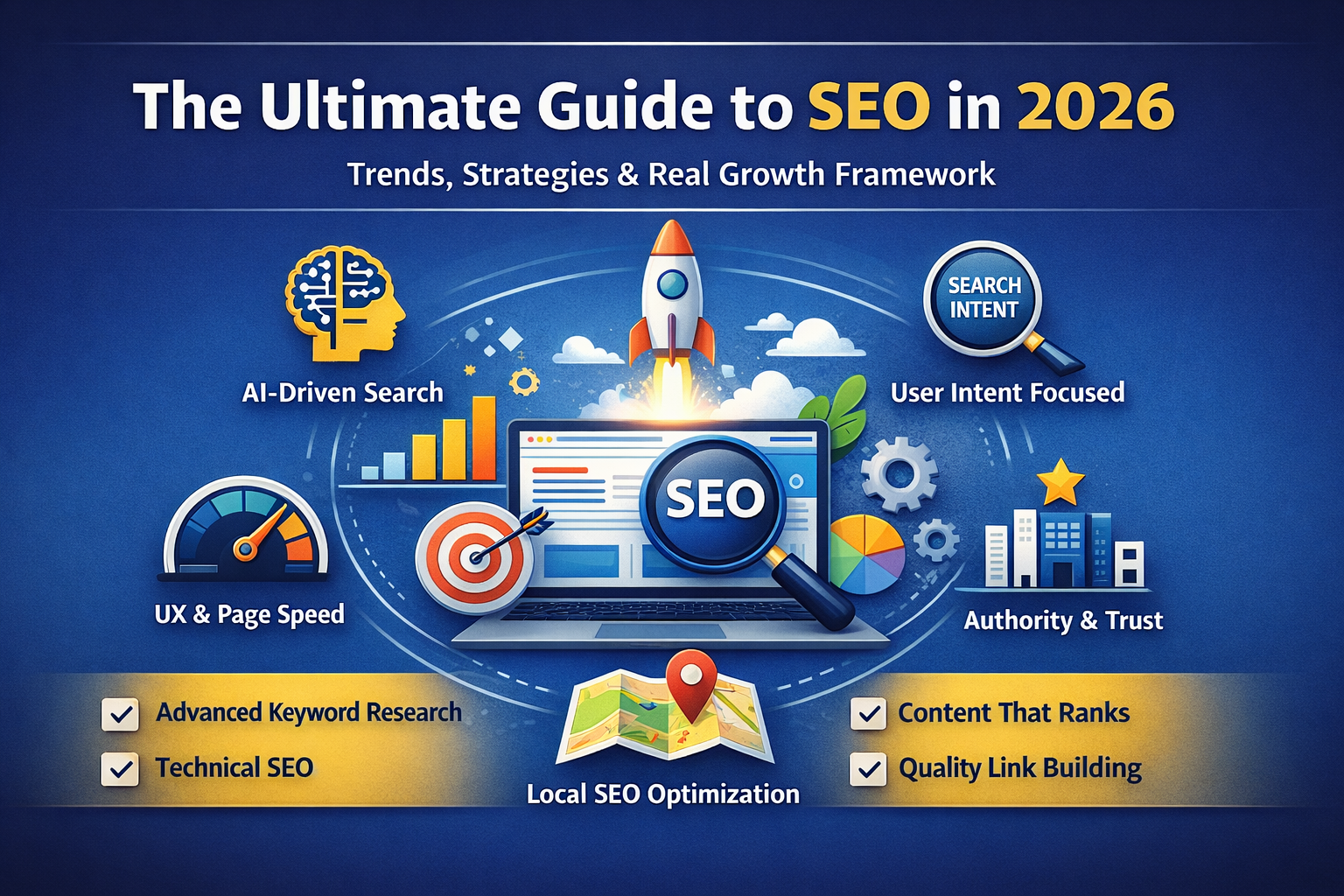
Search Engine Optimization (SEO) continues to evolve every year, and in 2026, ranking on Google requires more than just keywords and backlinks. Today, SEO is about user intent, content quality, website experience, authority, and AI-driven search behavior.
If you are a business owner, marketer, or entrepreneur looking to increase website traffic, generate leads, and build long-term online authority, this guide will walk you through everything you need to know about SEO in 2026.
This is not theory. This is a practical, business-focused SEO framework you can apply immediately.
1. What SEO Really Means in 2026
SEO is no longer just about ranking #1.
It is about:
- Being visible across search results
- Matching user intent perfectly
- Providing high-value content
- Delivering fast and seamless website experiences
- Building authority and trust
Google’s algorithm now evaluates:
- Content depth
- User engagement
- Page experience
- Brand authority
- Topical expertise
If your website is built only for keywords, you will struggle.
If your website is built for users first, you will win.
2. The Biggest SEO Trends in 2026
2.1 AI-Driven Search Results
AI-powered search engines analyze intent deeply. They understand context, not just keywords.
Instead of targeting:
“SEO services”
You now optimize for:
- What is SEO?
- How does SEO help small businesses?
- How much does SEO cost?
- How long does SEO take?
You must answer complete user journeys.
2.2 Search Intent is Everything
There are four types of search intent:
- Informational
- Navigational (find a brand)
- Transactional (buy something)
- Commercial investigation (compare options)
If someone searches:
“Best SEO company for small business”
They are not looking for a definition.
They want comparison, proof, and pricing clarity.
Matching intent improves rankings dramatically.
2.3 Topical Authority Wins Over Random Blogging
Instead of writing random blogs, build topic clusters.
Example:
Main Topic: SEO Services
Subtopics:
- On-page SEO
- Technical SEO
- Local SEO
- SEO for eCommerce
- SEO tools
- SEO pricing
When you dominate a topic fully, Google sees you as an authority.
2.4 User Experience (UX) Directly Affects Rankings
Ranking factors now include:
- Page speed
- Mobile responsiveness
- Easy navigation
- Low bounce rate
- Clear call-to-actions
If users leave quickly, rankings drop.
SEO and website development must work together.
3. Complete SEO Strategy Framework for 2026
Step 1: Advanced Keyword Research
Do not chase high-volume keywords only.
Focus on:
- Long-tail keywords
- Buyer-intent keywords
- Low competition opportunities
Example:
Instead of:
“digital marketing”
Target:
“digital marketing company for small business”
“affordable SEO services near me”
Long-tail keywords convert better.
Step 2: On-Page SEO Optimization
Each page should have:
- One primary keyword
- 2–3 secondary keywords
- Optimized H1, H2, H3 headings
- Internal linking
- Image alt text
- Optimized meta title and description
Avoid keyword stuffing.
Use natural language.
Step 3: High-Quality Content Creation
Google rewards:
- Original content
- Deep explanations
- Clear structure
- Actionable insights
Your content should:
- Solve real problems
- Include examples
- Be easy to read
- Provide step-by-step guidance
Content length matters when it adds value.
3000+ word guides often rank well when structured properly.
Step 4: Technical SEO Essentials
Without technical optimization, content alone will not rank.
Important technical factors:
- Fast loading speed
- Secure HTTPS
- XML sitemap
- Clean URL structure
- Mobile optimization
- Proper schema markup
If Google cannot crawl your site properly, you lose visibility.
Step 5: Link Building in 2026
Backlinks still matter.
But quality > quantity.
Focus on:
- Guest posting on relevant websites
- Industry directories
- Digital PR
- High-quality blog outreach
- Creating link-worthy resources
Avoid spammy backlinks.
4. Local SEO is Exploding in 2026
For service businesses, local SEO is powerful.
Optimize for:
- Google Business Profile
- Location-based keywords
- Local citations
- Customer reviews
- Location landing pages
Searches like:
“SEO company near me”
“Web development agency in [city]”
Have high conversion rates.
5. SEO + Paid Ads = Growth Multiplier
Smart businesses combine:
- SEO for long-term traffic
- Google Ads for immediate results
- Retargeting for higher conversions
This hybrid strategy increases visibility and brand authority.
6. Common SEO Mistakes to Avoid
❌ Keyword stuffing
❌ Buying cheap backlinks
❌ Ignoring mobile optimization
❌ Thin content
❌ Not updating old content
❌ No internal linking
Fixing these alone can improve rankings significantly.
7. How Long Does SEO Take in 2026?
Realistic timeline:
Month 1–2: Research & technical setup
Month 3–4: Content optimization
Month 5–6: Ranking improvements
Month 6+: Traffic growth & conversions
SEO is long-term, but the ROI compounds over time.
8. Future of SEO Beyond 2026
Expect:
- More AI integration
- Voice search optimization
- Visual search growth
- Video SEO dominance
- Brand authority signals becoming stronger
Businesses that invest early will dominate their niche.
Final Thoughts
SEO in 2026 is about strategy, not shortcuts.
If you:
- Create high-value content
- Optimize technically
- Build authority
- Focus on user experience
You will build sustainable traffic that grows month after month.
SEO is not an expense.
It is a long-term business investment.

Leave a Reply